The biggest misconception about YouTube automation in 2026 is earning “passive income”. People consider that they can earn passively in just a couple of months. That is simply not true. In reality, it requires a lot of effort. I have been involved in this industry for five years, serving as a manager, strategist, and writer. I’ve personally built and scaled five distinct channels. From my experience, success is a consistent process that requires a professional system. To construct a revenue-driven YouTube automation agency, you must treat this as a scalable business, not a hobby.
In this blog, I will take you through the YouTube automation step-by-step process. If you want to start earning through YouTube, then the YouTube automation business is probably the best shot in 2026. I will share the tips on how you can monetize a channel within three months without showing your face.
Why YouTube Automation is the Scalable Business Model in 2026
Starting a YouTube automation business is similar to starting your own small media firm, but without the significant overhead. While brainstorming to dominate the platform, you’re not just looking at a random side hustle idea. This is a business strategy that real people are adopting to make five, six, or even seven figures a year. Some people do it, and that’s called a faceless YouTube channel. The gap between “hobbyist creators” and “media companies” has grown as we move into YouTube automation 2026. Many creators believe that YouTube is saturated, but it’s not if you play it smart. In 2026, if you handle your channel like a factory instead of a creative undertaking, you may manage a portfolio that gets a lot of attention.
How and Why You Benefit from the Best YouTube Automation
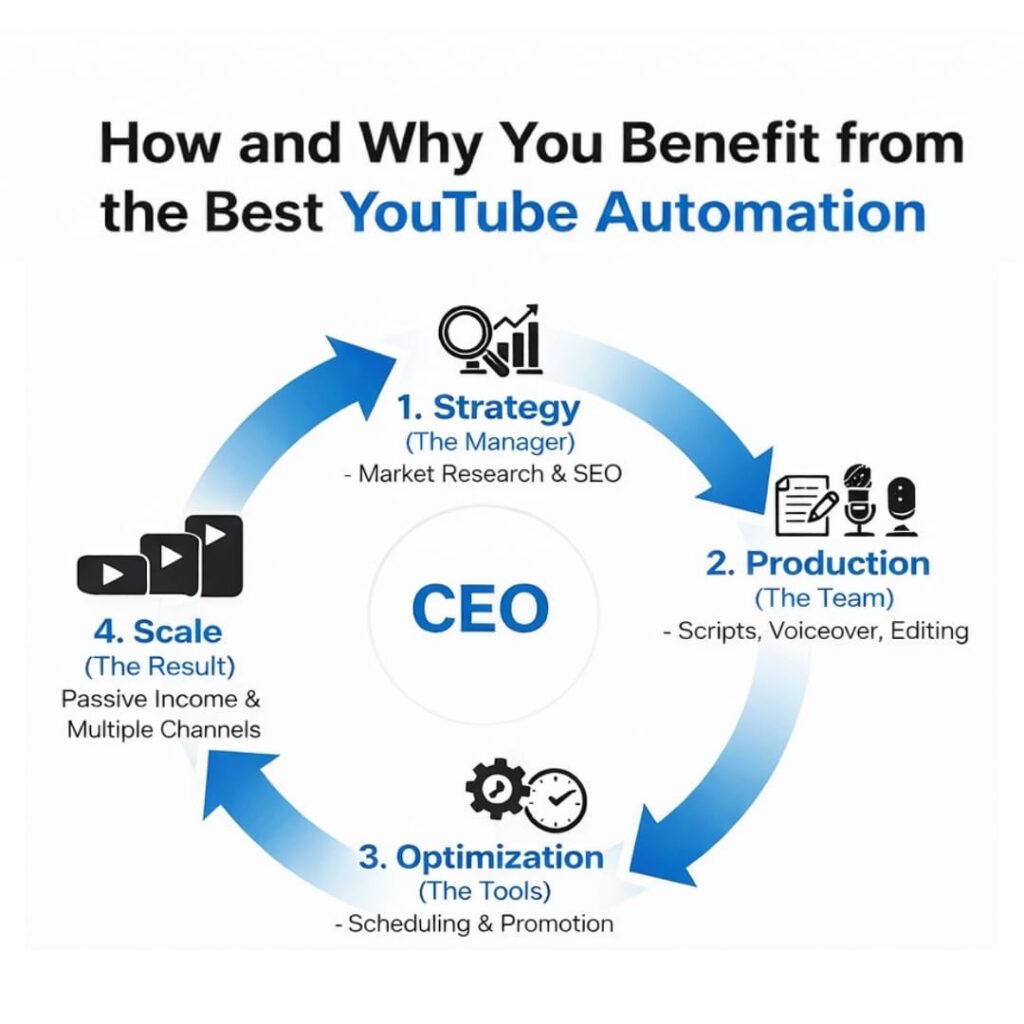
Hiring the best YouTube automation services is the most effective way to turn human hours into digital assets. When you use YouTube automation tools, you shift from being the labor to being the CEO. You create the content strategy, write scripts, edit videos, and design thumbnails to drive clicks. But trust me, it’s not the work of a one man. Instead of spending hours, you should hire a YouTube automation agency. The good thing is that you don’t even have to show your face or talk if you don’t want to. Above all, you need to create a system. Once you have a YouTube automation system, you can manage not just a single channel but multiple channels. You can scale them and start earning passive income, without exhausting yourself.
When Scalability Meets YouTube Automation Services
YouTube automation truly shines when you scale it the right way. Before starting a second channel, it’s preferable to focus on only one for at least six months. That patience establishes a strong base, and it pays off before you switch to the next channel. You can run more than one channel at the same time.
- Infinite Output:
With a good YouTube automation plan, you can make a lot more material. If you have the correct system in place, you can go from uploading one video a week to posting every day. It’s not possible for one person to handle that much work on their own. Without automation, the frequent programming, editing, uploading, and optimizing would quickly wear you out.
- Consistency at Scale:
The YouTube algorithm likes things to stay the same. Automation tools, such as scheduling platforms and AI voiceover services like ElevenLabs, keep your channel running all the time. Even while you’re sleeping, working on other things, or on vacation, your uploads keep on time. This constant involvement shows YouTube that you can be trusted and helps your channel develop.
Cost Efficiency:
You can pay for work based on output instead of hours with YouTube automation services or even a small group of talented freelancers. This makes the cost of your production fixed and easy to estimate. It’s lot easier to keep track of performance, figure out ROI, and grow your channels without having to guess about money when you have clear costs and regular content.
The Drawbacks: Why Some Best YouTube Automation Services Fail
Every business model carries risk, and YouTube automation is no exception. Every business strategy has its risks, and YouTube automation is no exception. If you automate your channel without careful planning and continual human monitoring, you could lose what makes it unique: its voice, trust, and relationship with its audience.
Where YouTube Automation Tools Fall Short
- Lack of Originality:
If you depend too much on YouTube automation tools, you could get “content farm” syndrome. If your scripts are made entirely by AI and don’t have any human reasoning, they won’t have the depth needed to keep a genuine audience interested. Another important concern is copyright infringement. If you use someone else’s content without their permission, you could get a channel strike. Always utilize music, pictures, and videos that you have permission to use.
Dependency on the Platform:
If you start a YouTube automation agency, you have to follow the YouTube algorithm. YouTube Automation 2026 has new rules about how to disclose AI content. You need to follow these rules, or it will cost your channel. Before producing any content, thoroughly examine the data. Don’t push concepts that are inappropriate or uninteresting to your audience. Gain information about your YouTube channel’s metrics. After determining what your audience truly wants to read or watch, you can provide content that appeals to them.
Initial Setup Cost:
If you want to run a YouTube channel, it means you already have some god-given talent. To run a successful channel, you need talented video editors and skilled scriptwriters. When a script is genuine, unique, and directly addresses the problems of the target audience, it attracts views naturally.
To grow your channel through YouTube automation, you must invest first, both time and money. However, investing time is more important than money. Earning passive income is not easy. You have to stay consistent and upload MORE than 40 videos before you start seeing real results.
What Happens if YouTube Creators Do Not Adopt YouTube Automation?
If YouTube creators don’t start using YouTube automation, they will have to deal with major problems, starting with burnout. It’s quite hard to do all of the writing, editing, uploading, and YouTube SEO work on your own. Consistency is the most important thing on YouTube, and just keeping it up can quickly use up a lot of time and energy.
Being a solopreneur means everything will be SLOW because you are in charge of everything. Creators have a hard time uploading consistently without automation, which hurts both their reach and the performance of YouTube’s algorithm.
Creators also miss out on SCALING. YouTube automation lets creators run more than one video, channel, or format at the same time. It is almost impossible to run four or five channels or even keep up with regular uploads without it. Because of this, income stays LOW.
Another big problem is missed chances. Automated creators post every day and take over niches, but manual creators fall behind since publishing every day is too much work. In short, not using YouTube automation means slower growth, more work, and missed long-term income. People who use automation make systems that work even when they don’t.
Defining the 2026 Automation Model
What is YouTube Automation, Really?
My precise definition of YouTube automation is a set of tools and a structured workflow that handles content production from strategy to upload. It allows you to outsource your planning, script writing, voiceovers, and editing.
Traditional vs. Automated Channels
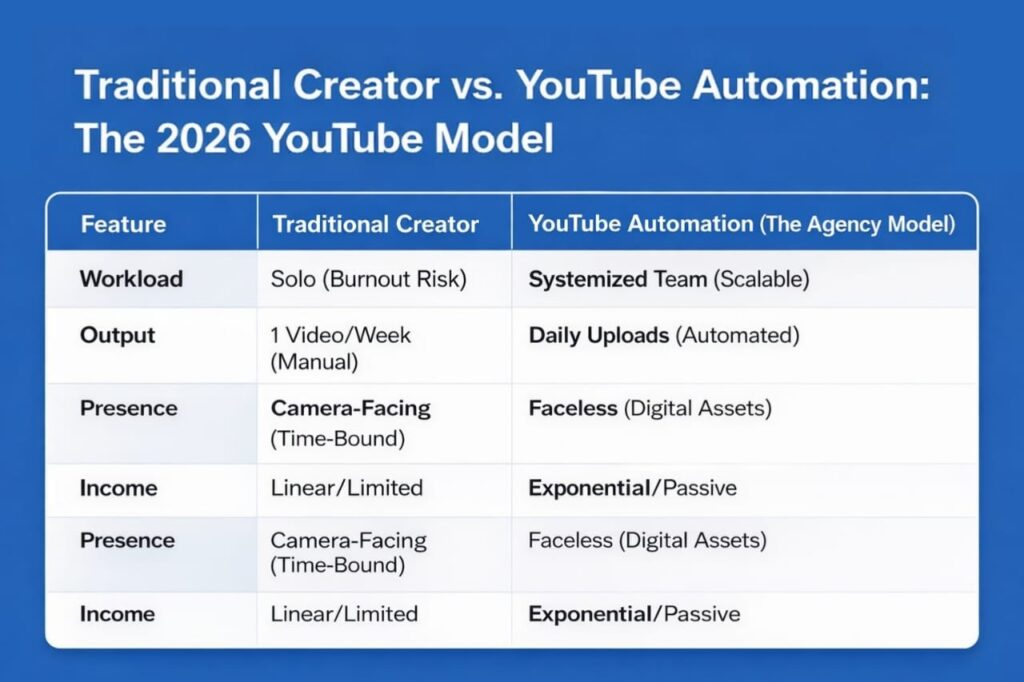
Traditional creators rely a lot on being there in person, spending time each day, and doing hands-on work for each video. How much work they can do on their own is what determines growth.
Automated YouTube channels don’t have any people in them and are run by computers. They use a team and automation tools to run the production. The owner of the channel is in charge of strategy and timing, while the system takes care of execution
The algorithm will favor deep relevance over raw volume in 2026. We don’t send out generic “AI spam” anymore. Instead, we send out high-quality, conversational content that solves problems for our target audience. The best YouTube automation services now focus on combining the speed of AI with the planning of people.
The Scalable Team Structure
To grow channels with YouTube automation, you need a team that acts as a well-oiled machine. As a manager, you are the architect.
Essential Roles for a Scalable Agency
- Strategist (Manager): This is usually you. You determine the trends, analyze the SEO keywords (like best YouTube automation), and manage the content calendar.
- Script Writer: The most underrated role. You need a powerful script that keeps people hooked. We use ChatGPT for structure, but human logic must refine it to ensure it’s motivational and educational.
- Voiceover Artist/Tool: We utilize ElevenLabs for consistent, professional narration. It provides the “faceless” quality needed for rapid scaling.
- Video Editor: This is often the bottleneck. The editor must choose pics and clips that align perfectly with the script. If the visuals don’t match the words, retention drops.
The YouTube Automation Step-by-Step Production System
Step 1: Finding Profitable, Evergreen Niches
To be successful on YouTube, you need to pick the right niche. If you pick the wrong niche, you could spend months working on videos that don’t get any views. If you pick the right niche, you could make money for a long time without having to do anything. Don’t just go with your gut; look at the data and what people want. Niches that are always in demand, like finance, technology tutorials, and self-improvement, do well because people are always looking for them.
Check demand with tools like TubeBuddy or vidIQ, and think about high-growth markets like India, which has more than 490 million YouTube users.
Step 2: Conduct Competitor Research
After you’ve chosen a niche, look at what’s already doing well. Competitor research is not about copying content; it’s about figuring out how to be successful.
Choose five to ten channels that are in the same niche, and make sure to include both big and small creators. Big channels show beginners what they can do, and small channels that grow quickly show what they can really do. Find niche-related keywords on YouTube and look at the number of subscribers, average views, and best videos.
Look at the titles and thumbnails of their videos. Pay attention to how questions, numbers, big claims, emotions, faces, text size, and colors are used. Then look at the structure of the video: how quickly value is delivered, where the hook is placed in the first 10 seconds, and how to keep viewers interested.
Step 3: Create Content Strategy
You need a clear plan after picking a niche and looking at what your competitors are doing. Growth becomes random without a plan. YouTube likes channels that stick to one topic and stay on topic.
For the first 50 videos, stick to one style of content. Random content confuses the algorithm, which slows down growth. Stories, tutorials, reviews, and lists are all formats that will make money in 2026. Reviews and how-to guides get more money because they get people to buy.
Put together a content cluster. Pick one main topic and make videos about it by breaking it down into smaller ones. This makes people want to watch more of your channel’s videos. Using the same thumbnails, fonts, and editing style all the time will help your brand stay strong.
Don’t set goals for your own sake; set goals for how well you do. For six months, you need to upload at least two videos every week. Pay attention to the click-through rate and the time spent watching. A clear plan saves time and helps your business grow over time.
Step 4: Leveraging YouTube Automation Tools
Automation tools for YouTube help creators get more views faster. You don’t need a lot of people. You just need the right people to do the right things. A basic setup needs a voice-over artist, a scriptwriter, a video editor, and a thumbnail designer.
A lot of creators hire cheap freelancers without checking them out first. This makes scripts sound robotic, edits boring, and thumbnails bad. Always hire skilled editors who know how to make videos that people will want to watch.
Make sure your workflow is clear. Keep track of things like scripting, voice-over, editing, thumbnails, and upload dates with simple tools like Trello or Google Sheets. You can use a specific stack:
- ChatGPT: For script outlines and brainstorming.
- ElevenLabs: For professional voiceovers.
- Editing Suites: (e.g., CapCut or Premiere) handled by our professional editor.
Your team can make great videos with this system while you work on growing the business.
Step 5: Maintaining Quality Benchmarks
YouTube SEO is most important when you want to optimize and schedule videos. Stop stuffing keywords. YouTube AI can understand your video by reading your title, description, and even listening to your voice-over.
Put your main keyword in three places where it fits in. Put it in the title, the first line of the description, and the first 30 seconds of the video. Tags are still useful, but keep them short. Use three to five tags that are similar to your title.
Use cards and end screens to keep people from leaving. Put an end screen on about 85% of the video and link to another video that is similar. This keeps people watching your videos, and YouTube promotes your channel more.
Always plan when you will upload. Don’t post at random. Choose a day and time and stick to it. You can find out when your audience is online by looking at YouTube Studio analytics. More viewers mean darker bars. Use that information to plan your day.
The quality of the content stays high only if the video editing matches the script perfectly. This is my usual standard. The editor must show relevant charts or clips right away if a script talks about “rising tile prices.” This visual demonstration is what keeps people interested.
Step 6: Monetization and Financial Scalability
Monetization is what every creator is looking for. You won’t make money with AdSense right away just by posting a few videos. The first step is to become a YouTube Partner. You need 1,000 subscribers and 4,000 hours of watch time, or 10 million views of your Shorts in 90 days. Long videos are usually more stable.
After getting the go-ahead, ad revenue starts out small. Finance, technology, and education can make $10 to $20 per thousand views. Niche entertainment sites usually make about $3. This is why it’s important to choose a niche.
Don’t depend on AdSense alone. Use it as a starting point. Include digital products, memberships, sponsorships, and affiliate marketing. If people trust them, even small channels can make a lot of money. Plan to make money early, especially if you use automation.
The Financial Roadmap
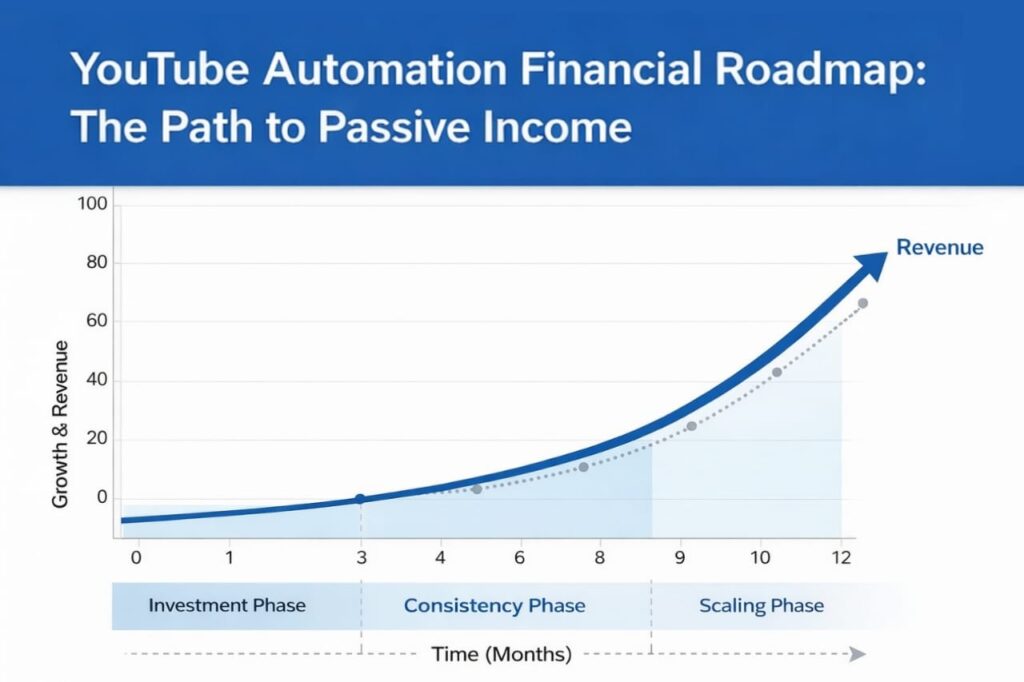
- Initial Investment: Tools and freelancers.
- Break-even Point: Usually occurs when consistency is met.
- The Scale: Once one channel earns $1,000/month, you replicate the system to launch a second. This is how you grow channels with YouTube automation into a multi-channel network.
Step 7: Avoiding the “Beginner Mistakes”
Myth: Passive Income is Instant
The biggest mistake people make about YouTube Earning is thinking they can make money from their channel in a few weeks. That’s not right. But the truth is that automating YouTube still takes time, work, and consistency. A lot of creators fail because they upload things at random times and give up too soon. They also don’t pay attention to trends and don’t match their visuals with their scripts, which hurts growth and watch time.
The “Saturation” Trap
A lot of people think that YouTube is too full, but the real problem is that there isn’t a system. Scaling is impossible if there isn’t a clear way to plan, write, edit, and schedule. A content pipeline must be ready ahead of time for an automated channel. Having a lot of videos in the queue helps keep things consistent and makes the algorithm happy.
Chasing trends without research.
Not every popular topic makes money. A topic can be popular but not make money or last long. NFT channels used to look good, but a lot of them fell apart when the market crashed. Before you jump on a trend, always check to see if there is long-term demand and a way to make money from it.
Cutting Corners on Quality
Poor editing, robotic voiceovers, and bad scripts all make it harder to remember. YouTube’s algorithm can tell right away when people stop watching. In the long run, saving money on quality often costs more. Bad production means fewer recommendations and slower channel growth.
Ignoring Analytics
Analytics tell you what your audience really wants. Not paying attention to data can waste time and hurt performance. A lot of creators keep posting things that people aren’t watching. Only when decisions are based on numbers like retention, CTR, and watch time does growth happen.
Copyright infringement.
Copyright Infringement Most creators don’t care about copyright issues. It’s a serious game on YouTube. If you use content without permission, you could ruin a channel. Strikes can cause a business to lose money or shut down. Always use music, pictures, and videos that you have permission to use. Safe content keeps your channel safe and helps it grow over time.
Build Your Media Company Today
To make YouTube automation a scalable business model, you need to go from being a “creator” to being a “manager.” It needs the best YouTube automation services, a strong script writer, and a way to make sure everything is in the right place. The fastest way to scale is to outsource channel management. Our YouTube channel management services handle everything so you can focus on business growth.
People don’t talk about consistency and process very much, but they are the most important things. If you treat this like a business by making a plan, scheduling your content, and keeping track of your goals, you will definitely succeed.
Are you ready to start your own YouTube automation business?