Here’s an uncomfortable truth for every brand owner, CEO, and founder reading this: your competitors are running fully automated YouTube channels right now, pulling in six and seven figures in ad revenue, affiliate income, and brand awareness, without a single employee on camera, without a studio, and without touching an editing timeline.
Meanwhile, you’re still treating YouTube like a “someday” project. Something you’ll “get to” once things slow down. They never slow down.
In 2026, faceless YouTube channel management isn’t a gray-hat hustle anymore. It’s a legitimate, board-approved growth channel. YouTube’s own algorithm has shifted in ways that reward exactly the kind of consistent, system-built content that AI workflows produce. If you’re a founder with capital, brand authority, and zero time to sit in front of a camera, let NGW manage a complete YouTube automation system for your business.
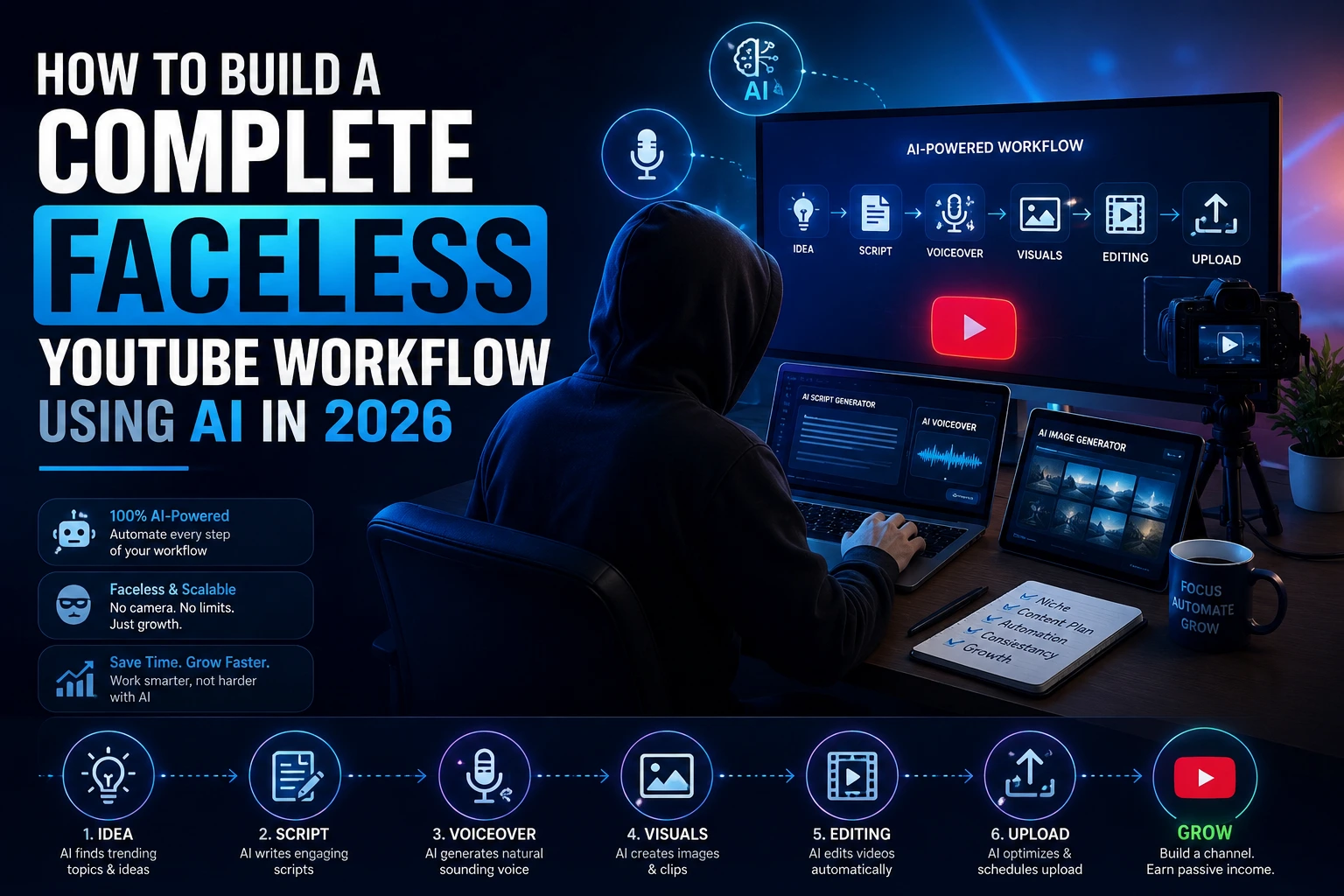
In this blog, you will get to know about the workflow with five interlocking pillars for building a faceless YouTube channel that runs like a department, not a side project.
Why YouTube Automation Is More Powerful Than Ever in 2026
Before we get into the Youtube automation workflow, you need to understand why 2026 is the year this works better than ever.
YouTube’s recommendation engine has moved decisively away from raw watch time and toward what insiders call session contribution, a composite score of engagement, satisfaction, and relevance measured across a viewer’s entire session, not just your video in isolation. The pattern YouTube now rewards is a viewer watching your video, engaging with it, then watching two or three more videos in the same session while the pattern it actively suppresses is a click followed by a twenty-second exit.
That single shift is enormous for automated channels, because it rewards systems, not one-off viral luck. A channel that reliably delivers satisfying, on-topic videos in a tight niche, the exact output of a well-built AI pipeline, trains the algorithm to trust it and push it further.
Three other 2026 changes matter directly to your strategy:
- Deeper micro-niche personalization. Since February 2026, YouTube’s Browse feed no longer groups videos into broad buckets like “business” or “finance.”.It now clusters videos based on individual viewer watch-history patterns, identifying micro-niches within a viewer’s interests and serving content accordingly. Translation: a hyper-specific, AI-researched niche will now outperform a broad one, because the algorithm literally has more precise shelving to put you on.
- Vision and audio models read your first five seconds. YouTube’s models now evaluate on-screen text in the first five seconds, thumbnail visuals, and spoken intros as ranking signals — not just titles and descriptions. Your AI workflow needs to be built around that opening window, not an afterthought.
- Small channels get tested faster, and “Hype” rewards early traction. YouTube has broadened a feature that lets viewers boost videos from smaller channels into dedicated discovery surfaces, adding a viewer-driven signal that can lift early-stage videos before standard recommendation data accumulates A new faceless channel, launched correctly, can break out faster than it could two years ago.
This is the environment your AI workflow needs to be engineered for. Now let’s build it.
Faceless YouTube Automation Step 1: AI-Powered Research and Content Strategy
Every automated channel that fails, fails here first. Founders skip strategy and go straight to “generate 30 videos,” and the algorithm punishes it because generic content gets filtered out faster than ever under YouTube’s more sophisticated matching systems.
Your research layer should answer three questions before a single script is written:
- What micro-niche, specifically, are we occupying? Not “finance” “cash-flow tactics for seven-figure e-commerce founders.” The narrower and more specific, the better the algorithm can cluster and serve you to the right micro-audience.
- What does search intent actually look like here? Use AI tools (ChatGPT, Claude, or purpose-built YouTube SEO tools like VidIQ or TubeBuddy’s AI layer) to pull real search queries, competitor gaps, and question-based long-tail keywords. Search is now weighted toward genuinely satisfying the query, not just matching it.
- What’s the content cadence a machine can sustain? Faceless channels win on consistency. Decide upfront: 3x/week, daily Shorts plus 2x/week long-form, or a hybrid. Build the calendar in a spreadsheet or Notion database that your AI pipeline can pull from automatically.
The tools: an LLM (Claude or GPT) for topic clustering and competitor gap analysis, a keyword tool for search volume validation, and a simple content calendar (Airtable, Notion, or Google Sheets) that becomes the single source of truth your entire pipeline reads from.
Faceless YouTube Automation Step 2: AI Scriptwriting for Higher Audience Retention
This is where most brand-run channels get lazy, they treat scripting as “ask ChatGPT for a script” and publish the first draft. That’s how you end up with the flat, generic pacing the algorithm now actively downranks.
A retention-engineered script for 2026 needs:
- A pattern-interrupt hook in the first 3–5 seconds that matches what your thumbnail promised — because vision models are now literally checking that alignment.
- A stated payoff within 15 seconds (“By the end of this video, you’ll know exactly how to X”) early value statements carry more algorithmic weight than they did a year ago.
- Loop structure, not list structure. Instead of “5 tips,” structure the script as an unfolding problem-solution arc that makes each section feel necessary to the next, this is what drives the “watch more of your session” behavior YouTube rewards.
- A built-in mid-roll re-hook around the 40–50% mark to combat drop-off, since completion behavior is tracked far more granularly now.
The workflow: Feed your AI (Claude works well for long-form structured writing) a strict template hook, payoff statement, three-act body, mid-roll re-hook, CTA, rather than an open prompt. Run every script through a second AI pass, specifically asking it to tighten pacing and cut filler. This two-pass method is the single highest-leverage step in the entire pipeline.
While AI can generate scripts in seconds, creating scripts that retain viewers requires editorial expertise. NGW combines AI drafting with human refinement to ensure every script aligns with brand voice, audience expectations, and YouTube’s retention-focused algorithm.
Faceless YouTube Automation Step 3: AI Video Production and Editing
This is the part that used to require a team. In 2026, it requires a stack.
- Voice: AI voice tools like ElevenLabs now produce narration close enough to human that retention isn’t hurt by using them, provided you choose a voice with natural pacing and add slight variation in tone rather than one flat setting.
- Visuals: Stock footage APIs, AI image generation, and B-roll automation tools (Pexels/Storyblocks APIs combined with AI-selected relevant clips) can be matched to your script section-by-section using metadata tagging, so the pipeline pulls visuals automatically rather than manually.
- Editing: Tools built specifically for faceless automation (like the current generation of AI video assemblers) can take script + voiceover + B-roll and auto-cut a full video, complete with captions burned in — critical, since expressive captions are now a core relevance signal, not a nice-to-have.
- Thumbnails: Generate 3–5 AI thumbnail variants per video and A/B test them. Since thumbnails are now cross-checked against your spoken intro by YouTube’s models, keep the visual promise and the opening line perfectly aligned.
The build: Most brand teams stitch this together with a workflow automation tool (Make.com or n8n) that triggers each step — script approved → voice generated → B-roll assembled → captions added → thumbnail options generated — without a human touching the software in between.
Rather than asking businesses to manage five or six different AI platforms, NGW integrates voice generation, AI visuals, automated editing, captions, thumbnails, and workflow automation into one streamlined production pipeline. The result is a scalable content engine capable of producing consistent, high-quality videos without the complexity of managing multiple vendors.
Faceless YouTube Automation Step 4: Publishing, YouTube SEO, and Distribution
A finished video sitting unpublished is a wasted asset. This pillar is about removing yourself from the “upload and configure” bottleneck entirely.
- Metadata automation: Titles, descriptions, and tags should be generated by AI directly from your script and keyword research — not written fresh each time. Build a prompt template that outputs YouTube-ready metadata formatted to your channel’s style guide.
- Scheduled publishing: Use the YouTube API or a scheduling layer inside your automation tool to queue uploads at your channel’s optimal watch-time windows, based on your existing analytics.
- Shorts repurposing: Every long-form video should automatically spin off 2–4 Shorts, because Shorts now run on a completely separate algorithm with its own discovery engine and 200 billion daily views up for grabs. Since Shorts and long-form performance don’t cross-pollinate the way they used to, treat your Shorts output as its own growth lane — not just promotion for the main video.
- Cross-platform echo: Auto-post the same short-form assets to Instagram Reels and TikTok through a single automation trigger, extending reach without extending your team’s workload.
The rule of thumb: if a human is manually typing a title into YouTube Studio in 2026, that’s a broken workflow. Everything from script-lock to live video should be a chain of automated handoffs.
One more thing worth flagging for brand owners specifically: search relevance now runs deeper than keyword matching. YouTube’s search ranking increasingly evaluates whether a video actually satisfies the query, watch time from search, drop-off points, and swipe-away behavior all factor in. That means your metadata automation can’t just stuff keywords into a title; the AI generating your titles and descriptions needs to be prompted to reflect the actual payoff of the video, because a mismatch between promise and delivery gets penalized fast under the current system.
Budget, Team, and What This Actually Costs a Brand
CEOs reading this will rightly want to know what it costs to stand up. Realistically, a lean faceless YouTube operation in 2026 breaks down into three cost centers:
- Tooling stack: an LLM subscription, an AI voice tool, a stock/B-roll footage license, an automation platform (Make.com or n8n), and a keyword research tool. Most of this runs $300–$800/month depending on volume.
- Human oversight: Many businesses discover that purchasing AI subscriptions is only a small part of the investment. Building workflows, training staff, maintaining automation, and troubleshooting integrations often become the real costs.
Working with NextGlobalWave eliminates much of that operational burden. Instead of assembling an internal YouTube production department, companies gain access to a ready-built AI workflow, experienced strategists, editors, automation specialists, and ongoing optimization under one partner.
We help you to built AI workflow that gets you 80–90% of the output quality at a fraction of the headcount, and it scales without the linear cost increase that comes with adding more human editors for more videos.
Faceless YouTube Automation Step 5: Analytics and Continuous Optimization
This is the pillar CEOs consistently underinvest in, and it’s the one that compounds fastest.
YouTube Studio now gives you granular, moment-by-moment retention data, and the winning approach is to treat every video as a test, not a finished product. Build a weekly review ritual (even if it’s AI-assisted) that pulls:
- Average view duration and where the steepest drop-offs happen
- CTR by thumbnail variant
- Which topics are producing session contribution (viewers watching more of your other videos afterward) versus which are one-and-done
- Search vs. Browse vs. Suggested traffic split, so you know whether to lean into SEO-driven titles or discovery-driven hooks
Feed this data back into your Pillar 1 research layer monthly. Kill underperforming formats fast, and double down on whatever is producing session contribution because that’s the metric the algorithm is currently built around, and it’s the one most brand teams still ignore in favor of vanity view counts.
The system: Data only becomes valuable when it informs future decisions. NGW continuously monitors retention, click-through rates, audience behavior, and session contribution to refine content strategies, allowing channels to improve month after month instead of relying on guesswork.
Putting It Together: What This Actually Looks Like Running
When these five pillars are properly connected, here’s what a week looks like for your team:
- Monday: AI research layer surfaces 10 validated topics from the content calendar.
- Tuesday: Scripts generated and passed through the two-pass retention edit.
- Wednesday: Voice, B-roll, and captions auto-assemble into rough cuts.
- Thursday: Thumbnails generated, A/B pairs selected, metadata auto-written.
- Friday: Videos scheduled, Shorts spun off, cross-platform posts queued.
- Ongoing: Analytics loop feeds back into the following week’s topic selection.
This is what “faceless YouTube” actually means for a brand or executive in 2026: not a hidden identity, but a hidden bottleneck. You’re removing yourself as the constraint on a channel that can scale independently of your calendar.
Build Your AI-Powered YouTube Growth Engine with NextGlobalWave
The brands winning on YouTube in 2026 aren’t simply using AI; they’re using AI through well-designed systems. Research, scripting, production, publishing, SEO, and analytics all work together as a single workflow.
NextGlobalWave helps founders, CEOs, personal brands, and enterprises build exactly that. From YouTube strategy and AI-powered content creation to automation, optimization, and ongoing channel management, NGW delivers complete faceless YouTube workflows designed for long-term growth, not just individual videos.
If you’re ready to launch a scalable YouTube channel without building an in-house production team, NextGlobalWave can help you implement an end-to-end automation workflow that turns YouTube into a predictable growth asset for your business.